
Artists
Sheila Hicks Made Her First Loom From Painting Stretchers
Milan presented Italy’s first Sheila Hicks retrospective on 16 November. A loom made from painting stretchers and a new outdoor work tell the story of how she took weaving into architecture.
In the late 1950s, Sheila Hicks took the wooden stretchers normally used to hold a canvas and put them to another use. She strung threads across them to make a small loom. Hicks was studying painting at Yale, and her research into ancient Peruvian textiles had led her to a practical question. To understand a woven object, she had to find out what happened when one thread passed through another.
On 16 November, the City of Milan presented Italy’s first retrospective of Hicks at the Padiglione d’Arte Contemporanea. In the Thread of Love opens to the public on 17 November and runs through 14 February 2027. Curator Diego Sileo brings together more than 100 works spanning over six decades, including loans from MoMA and Amsterdam’s Stedelijk Museum. The exhibition moves from early experiments to installations conceived with the shape of Ignazio Gardella’s pavilion in mind.
What a small loom can hold
The first loom helps explain the small weavings Hicks calls Minimes. She made them alongside much larger commissions and kept returning to the format throughout her career. One example in MoMA’s collection, the hand-woven wool Multi-Colored Minime of around 1962, measures 26.7 by 29.2 centimetres. That is roughly the size of a record sleeve. A piece that small lets the eye follow where threads cross and where a change in colour is also a change in texture.
Those experiments had roots in particular places and practices. Hicks travelled through South America on a Fulbright grant and spent several years in Taxco el Viejo, Mexico, where she worked with local artisans. The curators of her survey at Instituto Tomie Ohtake trace how her study of Andean textiles informed the way she handled tension and structure. Their account makes the early pieces easier to read as experiments in construction, with the position of each thread shaping what the whole surface can do.
At New York’s Ford Foundation, the scale of the question changed. In 1967 Hicks installed two bas-relief tapestries in the building’s meeting spaces, working with its architects to fit them into the rooms. When the originals deteriorated, she and her team spent about a year remaking them. The new textiles use more than a thousand hand-stitched medallions. Up close, each unit has an edge and a thickness. From across the room, the units read as a continuous field.
Back to Milan
For the park at Villa Reale in Milan, Hicks made Homage to Piero Dorazio, a new work dedicated to the Italian painter she met in the city in 1962. In the project room, a separate exhibition curated by Silvia Bignami traces the encounter through archival material. Hicks saw something akin to weaving in Dorazio’s grids of intersecting lines. The outdoor commission offers a chance to follow an idea from a painter’s surface through a textile artist’s studio to the grounds of a public pavilion.
Sources
- City of Milan. Presentation of the retrospective, 16 November 2026
- PAC. In the Thread of Love, exhibition details and tickets
- PAC. Interlacing Colours and the 1962 encounter
- Instituto Tomie Ohtake. Hicks’s early looms, travels and Minimes
- MoMA. Multi-Colored Minime, c. 1962
- Ford Foundation. The 1967 tapestries and their recreation
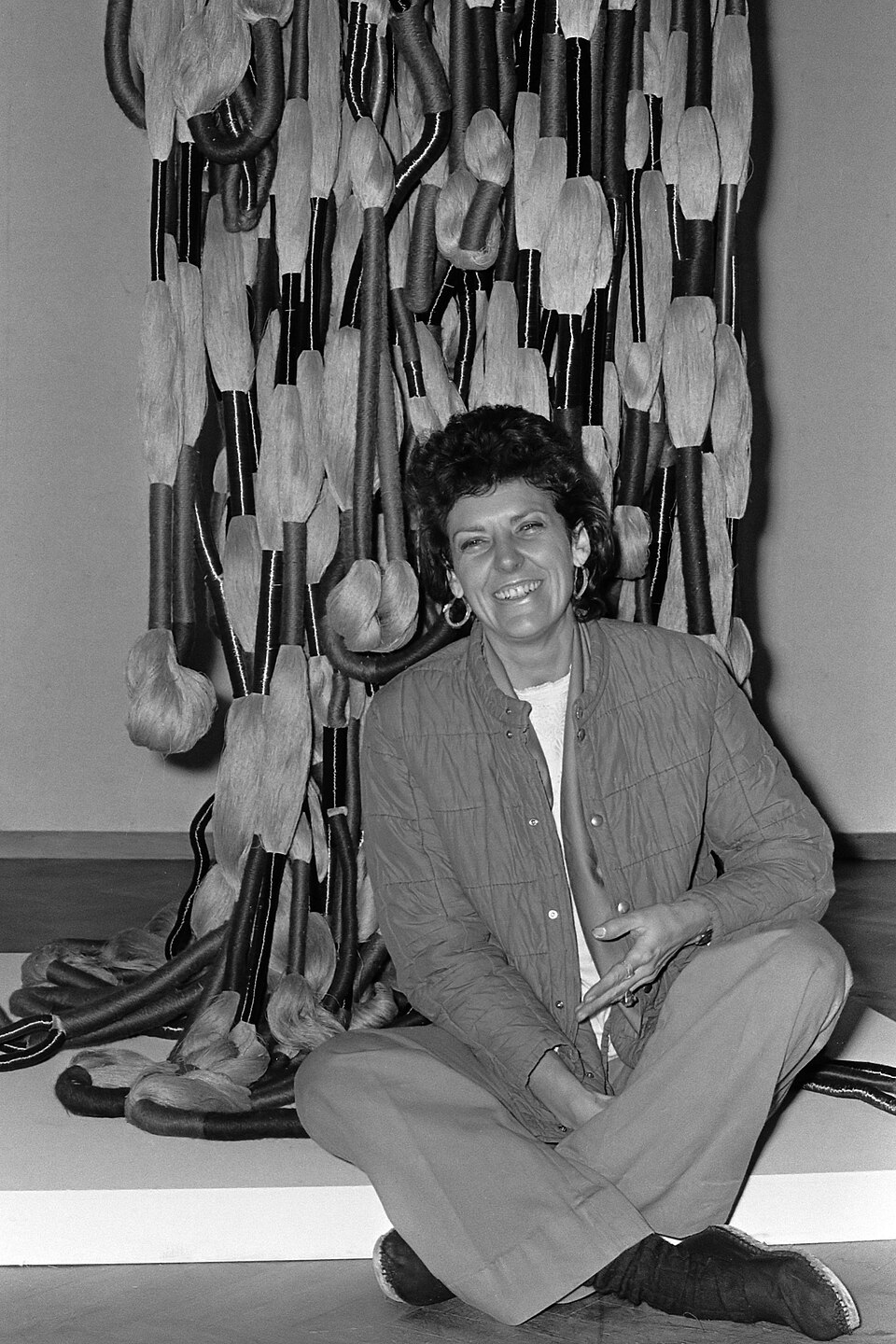
Cover image Sheila Hicks at the Stedelijk Museum in Amsterdam, 1974. Archive photograph by W. Punt / Anefo, Nationaal Archief via Wikimedia Commons. CC BY-SA 3.0. Cropped versions are shared under the same licence.

