
Art World
An Old Museum Reopens With a Question About What Survives
Michael Rakowitz’s exhibition is scheduled to open at Athens’s Old Acropolis Museum on 23 November. A building closed to the public since 2007 brings contemporary art into a new encounter with archaeological memory.
Visitors heading up the Acropolis on Monday evening will be going somewhere that has been out of ordinary public reach for nineteen years. The Old Acropolis Museum is welcoming audiences again, with Michael Rakowitz’s What You Leave Behind is Not What is Engraved scheduled to open on 23 November. Its title puts an awkward question inside a place built to preserve things: is a material trace the same as a legacy?
A museum beneath the monument
The building is easy to overlook beside the monuments above it. Designed by Panagis Kalkos and constructed between 1865 and 1874, much of it sits below the hilltop. Renovation sponsor PCAI describes this reopening as its first welcome to visitors since 2007.
The archaeological authority’s account supplies the reason for the earlier closure: objects had to be dismantled and packed for transfer to the new museum. Its redevelopment plans envisaged access to archaeological material alongside storage, study and conservation. Reopening a museum can therefore change more than its address on a visitor’s itinerary. It can make the work behind a collection more legible.
Packaging beside the idea of permanence
The exhibition completes Michael Rakowitz & Ancient Cultures, a trilogy presented with Greece’s Ministry of Culture and NEON. Rakowitz’s wider practice offers a useful point of entry. His gallery records a 2025 version of the Code of Hammurabi made from Arabic newspapers, food packaging and other materials. His 2018 Lamassu of Nineveh used 10,500 Iraqi date-syrup cans. These examples establish the artist’s vocabulary; they are not a checklist of works confirmed for this new exhibition.
Such materials make the contrast with carved stone especially productive. Packaging carries everyday languages, trade and consumption into a form associated with historical authority. An object can resemble something durable while advertising its own fragile construction. That tension helps explain why Rakowitz is an interesting presence in an archaeological setting: the question becomes how a culture is remembered, as well as what has physically survived.
The programme also includes archaeological displays and Parthenon Alive, a digital project developed by the Technical University of Crete with the Ephorate of Antiquities of the City of Athens. Contemporary reconstruction and archaeological presentation share a site, while retaining different methods and claims.
Tonight’s opening has specific limits
NEON lists the opening for Monday, 23 November, 17:00–21:00 Athens time, with last admission at 19:30. Entry is free, but reservation confirmation and ID or passport are required. The organiser warns that limited capacity means first-come admission and brief visits during the opening. Those conditions concern this event, not a general promise of unrestricted museum access.
This is a preview based on the confirmed programme, rather than a report from inside the exhibition. The evening’s most consequential proposition is already clear: bringing a contemporary artist into a reopened archaeological museum invites visitors to examine how preservation produces a story.
Sources
- NEON: 23 November opening, programme and access
- PCAI: reopening and building history, 17 November 2026
- Athens archaeological authority: closure and redevelopment
- Green Art Gallery: documented works and materials
- Green Art Gallery: exhibition date and trilogy
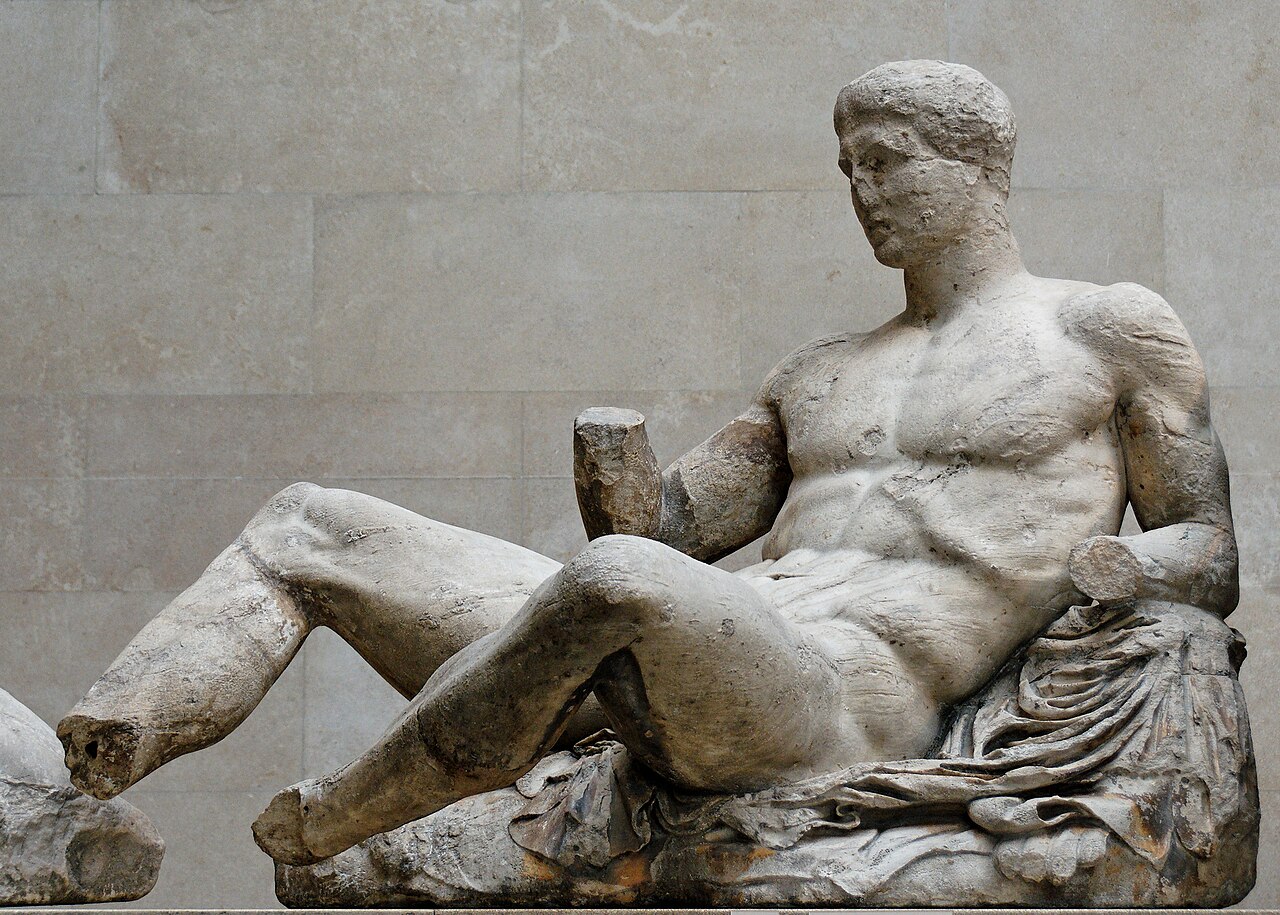
Image credit: Archival context photograph: Parthenon east-pediment figure in London, not the Old Acropolis Museum or a work by Rakowitz. Marie-Lan Nguyen, 2007, via Wikimedia Commons, CC BY 2.5. Resized; previews may be cropped.

