
Art World
A Drill Hole Can Change the Parthenon
A new exhibition opening in Frankfurt on 18 November pieces together Athena’s birth from damaged marble, digital scans and competing clues. Its most interesting question is how much of a lost image we can really know.
A drill hole, a broken edge, a mark left by a tool: these are the details on which a lost monumental scene can turn. Opening on 18 November 2026, Bühne frei für Athena: Das Parthenon-Puzzle at Frankfurt’s Liebieghaus presents a new proposal for reconstructing the Parthenon’s east pediment.
Vinzenz Brinkmann’s team reassessed around sixty surviving fragments using 3D scans, ancient texts and Roman sculptures that repeat lost Greek models. The exhibition separates surviving material, newly proposed identifications and the resulting composition into three stages. An animation brings that proposed ensemble together. The word “proposal” matters: a complete image and complete certainty are different achievements.
A birth scene with its centre missing
The pediment was the triangular space above the temple’s eastern façade. Its subject was Athena’s birth from Zeus’s head, watched by other gods. At the edges, the rising sun and setting moon established the scene at dawn, as the Acropolis Museum explains. Much of the sculpture has been destroyed; surviving bodies and fragments have to carry an enormous interpretive burden.
One head in the Athens collection makes the problem unusually tangible. Reassembled from three fragments, it has been interpreted as belonging to a goddess, possibly Hera or Eileithyia, or to a male figure, perhaps Helios. Two pieces were found in different places in 1984 and 1990. An apparently single object can therefore contain several histories of discovery and several possible identities.
Even a familiar figure can remain a question
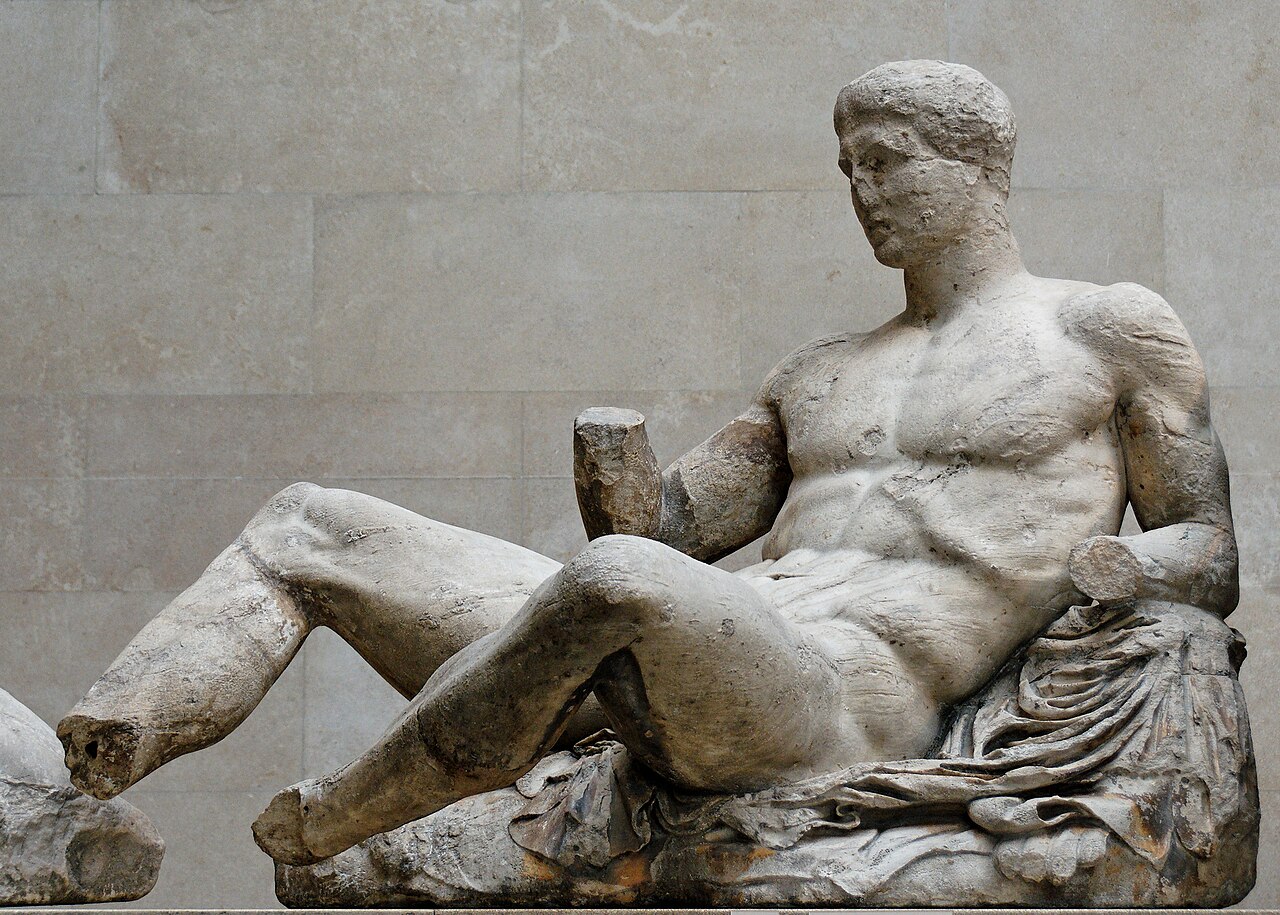
The reclining young man often called Dionysos offers another warning against easy labels. The Acropolis Museum also records proposals identifying him as Herakles or Theseus. His original marble figure is in the British Museum; Athens displays a plaster cast. A missing hand once held a vessel, while a small ankle hole may have secured a bronze ornament. Details that look incidental can change how a body is read.
For viewers, the useful challenge is to ask where each reconstruction moves from visible evidence to inference. Does a physical join establish a connection? Does a comparable statue suggest a pose? Does the proposed arrangement make the surviving pieces intelligible? These are different kinds of argument, even when an animation makes them look equally seamless.
That distinction gives the Frankfurt opening relevance beyond archaeology. Digital images can make an incomplete past look finished. Showing the steps behind an image lets a museum turn that persuasive power into something its audience can examine.
The exhibition runs until 25 July 2027 at Liebieghaus Skulpturensammlung, Schaumainkai 71, Frankfurt am Main. The museum lists an opening-day overview tour on Wednesday 18 November at 13:00.
Sources
- Liebieghaus: research methods and reconstruction stages
- Liebieghaus: exhibition and dates
- Acropolis Museum: head fragment and the east pediment
- Acropolis Museum: the figure usually identified as Dionysos
- Liebieghaus: 18 November programme
Image credit: Marie-Lan Nguyen, 2007, via Wikimedia Commons, CC BY 2.5. Archival photograph of a Parthenon sculpture in London, not an installation view of the Frankfurt exhibition. Resized; preview may be cropped.

