
Artists
Why Monet Kept Painting the Same Stacks of Wheat
In a field near Giverny, a familiar subject gave Claude Monet a way to paint different hours and seasons.
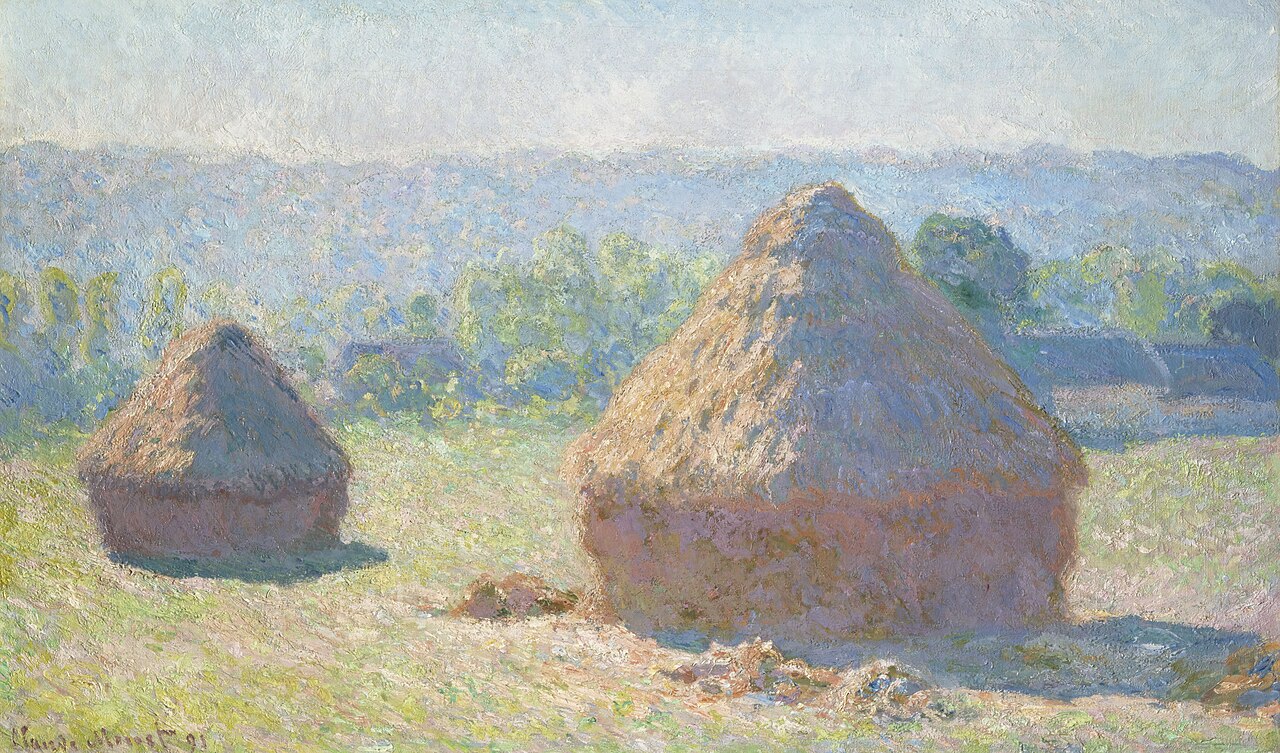
Two stacks of harvested wheat sit high in a wide field in Claude Monet’s Stacks of Wheat (End of Summer). The field appears to continue past the edges of the canvas. The nearer stack is broad and close to us. The second stands farther back. Almost everything else is a question of light.
Monet painted stacks near his home in Giverny in 1890 and 1891. He came back to the subject in different weather and seasons. The Art Institute of Chicago holds several paintings from this group, making it possible to compare how the same kind of object changes in warm late-summer light or under snow.
Watching what changes
The stacks give each painting a shape the eye can find immediately. Once you know what is there, you can look at the edges and shadows. In a warm painting, a stack may feel heavy and close. Against a pale winter field, colour around the edge can carry more of the sense of distance. The effect comes from the relationship between the stack and the land around it.
The Art Institute’s technical catalogue also documents choices beneath the surface of the paintings, including the canvas and the preparation of the ground. It is worth having that detail in mind when looking at a motif often associated with immediacy. The series involved repeated decisions about where to place the stacks on each canvas and how to make different atmospheric conditions visible in paint.
Try looking at two versions without reading their names first. The change in air or temperature can register before you identify which season the title gives you.
Sources
- Art Institute of Chicago, catalogue entry for Stacks of Wheat (End of Summer)
- Art Institute of Chicago, scholarly catalogue on Monet’s wheatstacks
Cover image: Claude Monet, Stacks of Wheat (End of Summer), 1890–91. Art Institute of Chicago. Claude Monet / Art Institute of Chicago, Public domain. Cropped in previews.

