
Berlin
Who Gets to Call Someone a Monster?
Marven Rabe’s forthcoming Berlin talk follows the werewolf from fascist mythology to queer online culture. It opens a new route into Monströs, the group exhibition at Galerie im Turm.
A werewolf does not stay on one side of a boundary. That makes it a useful figure for an artist working across video, performance and costume—and a difficult mascot for any politics demanding fixed identities. On Friday, 27 November, Marven Rabe brings that problem to Berlin’s Galerie im Turm in the English-language talk Projecting Bestiality.
A creature with competing owners
The announced route runs from the Nazi “Operation Werwolf” of 1944 through the “Gay Furry Hackers” of 2024, taking in films including Twilight, Underworld and Ginger Snaps. The gallery describes an inquiry into the motif’s political associations and its resistance to ideological capture.
Putting those references in one conversation does not make their politics equivalent. It offers a way to ask how an image changes when a different group adopts it. The same unstable body might be made to police a boundary or to challenge the demand that the boundary exist.
Horror as a way of reading power
The talk belongs to Monströs, the exhibition by Emma Adler, Caroline Douville, Rabe and Milena Wojhan, curated by Carlotta Gonindard Liebe. It began its public run on 19 November after the previous evening’s opening and continues until 24 January 2027. The district’s announcement frames the monster as a figure that can expose exploitation and colonial continuities while also serving as a label imposed on people.
That double use is the exhibition’s strongest question. Calling a body monstrous can make exclusion look natural. Claiming the figure for oneself can undermine the authority to decide which bodies belong. A visitor need not arrive with specialist theory to recognise the everyday stakes of that dispute.
The artists’ published practices suggest different ways into it. Adler investigates online propaganda and manipulated representations; Douville works with Haitian histories, archives and the zombie figure. These are descriptions of their broader practices supplied by the gallery, not claims about particular installations observed on a visit. The distinction leaves room to encounter how the exhibition actually brings its arguments into material form.
An institution inside a familiar tower
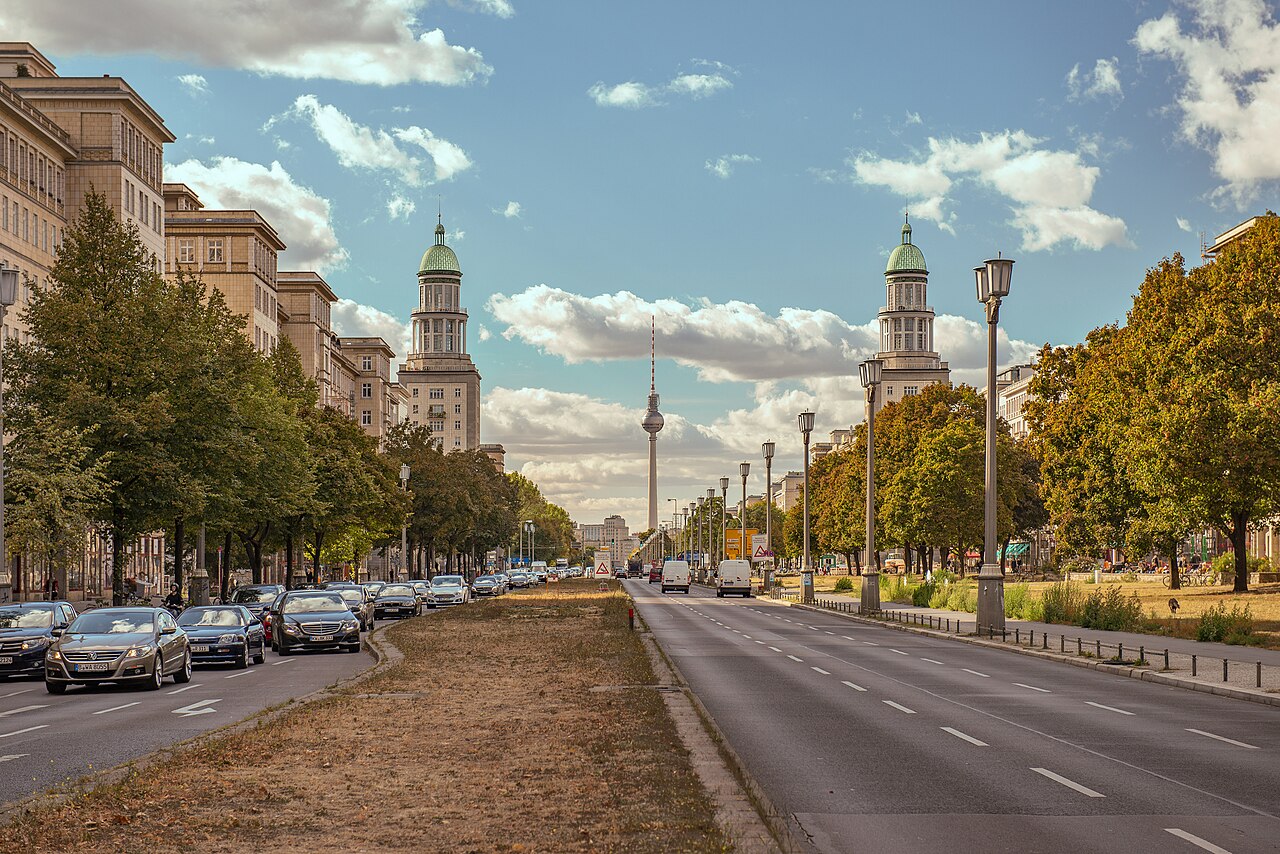
Galerie im Turm occupies the ground floor of the northern Frankfurter Tor tower. Founded in 1965, it has operated as a municipal gallery since 1990. That public setting gives an apparently fantastic subject an ordinary urban address: Frankfurter Tor 1, 10243 Berlin.
Rabe’s talk is listed for 18:00–20:00 on Friday, 27 November, in English. The event page supplies no ticket price or booking requirement; check its current information before attending. Regular gallery hours are Monday–Friday 12:00–18:00 and weekends 14:00–19:00. Step access can be bridged with a mobile ramp with staff assistance; the gallery’s toilet is not wheelchair accessible.
We previously included the exhibition opening in our 16–22 November calendar. This follow-up focuses on the forthcoming talk: a chance to examine how a familiar fictional creature becomes a contested political image.
Sources
- Galerie im Turm: talk, references, language and time
- Galerie im Turm: exhibition, artists and curator
- District of Friedrichshain-Kreuzberg: dates and curatorial premise
- Galerie im Turm: history, opening hours and accessibility
Image credit: Frankfurter Tor, Berlin, 25 September 2018. Archival city photograph by Marek Śliwecki via Wikimedia Commons, CC BY-SA 4.0. Not an exhibition view. Resized; preview crops remain under the same licence.

