
Artists
One Great Wave, Many Original Prints
Hokusai’s famous wave was printed from blocks. Looking at different impressions shows what an original can mean when a work was made in multiples.
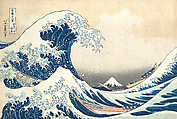
The wave comes in from the left and curls towards the boats. Far beneath it, a small triangle of white rises above the horizon. That is Mount Fuji. Hokusai made it the quietest element in one of the most widely reproduced prints in the world.
Under the Wave off Kanagawa belongs to his series Thirty-six Views of Mount Fuji. It is a colour woodblock print from the early 1830s. The image depends on a process that could make multiple impressions from the blocks. A sheet in one museum and a sheet in another can each be an original impression.
Where the print gives itself away
Look at the line drawn along the water on the right. The British Museum points to a small gap in that line as a clue to the stage of printing, because repeated use can damage tiny parts of a printing block. Other details vary with the condition of the blocks, the inking and the paper. A familiar outline is a useful starting point for looking at differences between individual sheets.
The blues offer another way in. The Metropolitan Museum of Art’s close study traces the print’s use of Prussian blue and its combinations with other colour. On a screen, where every reproduction can be adjusted, it helps to look at impressions side by side from collections that describe the object and how it was made.
Start with Fuji, then follow the fine lines that run along the boats. The headline image will still be there. What becomes visible is the printmaker’s way of making water, distance and human scale fit on a single sheet.
Sources
- The Metropolitan Museum of Art, collection record and public-domain image
- The Metropolitan Museum of Art, The Great Wave: Anatomy of an Icon
- British Museum, Hokusai exhibition guide and printing details
Cover image: Katsushika Hokusai, Under the Wave off Kanagawa, early 1830s. Woodblock print. Katsushika Hokusai / The Metropolitan Museum of Art, Public domain. Cropped in previews.
