
Art World
A Pledge of 56 Glass Works Comes With a Curatorial Post
The National Gallery of Canada has announced a promised Bronfman gift spanning Tiffany to studio glass. Its accompanying endowment makes the story about the people who research a collection as well as the objects it contains.
A collection can arrive with more than objects. On 20 November 2026, the National Gallery of Canada announced a promised gift of fifty-six modern and contemporary glass works from Charles and the late Andrea Bronfman. Alongside it comes an endowment intended to establish a curatorial position devoted to decorative arts and design.
That second part deserves attention. A museum needs someone to ask what an object is, how it was made and which other works should sit beside it. Funding that work can shape a collection long after an announcement has passed.
More than a beautiful surface
The promised gift crosses different ways of using glass: works by Tiffany, Émile Gallé and Daum sit within a larger history that also includes Harvey Littleton, Lino Tagliapietra, Dale Chihuly and Toots Zynsky. The range resists treating the material as a single decorative category.
Studio glass offers one useful distinction. As the Corning Museum of Glass explains, the movement enabled artists to work with hot glass in their own studios, independently of factories. A small furnace and readily melted glass developed by Littleton and Dominick Labino in 1962 helped make that shift possible.
The change concerned who could experiment directly with the material. It provides a practical way to approach glass sculpture: ask about the relationship between the person who conceived a form and the person who made it, rather than stopping at its colour or shine.
A gift needs a future
Reporting independently on the announcement, The Art Newspaper identifies twenty-nine artists in the promised collection. It also reports that the gallery has not disclosed the size of the accompanying endowment. The new position is intended to support research, exhibitions and further acquisitions.
The distinction between a promised gift and a completed transfer matters. The announcement establishes a commitment; it does not provide a timetable for every object to change hands. A selection is already on display at the gallery until 30 April 2027, giving visitors something concrete to see while the larger institutional project develops.
Our reading is that the endowment may be the most consequential part. Objects can enter a collection without immediately becoming part of its public story. Dedicated expertise creates a better chance of connections being researched, explained and tested in future displays. That is an opportunity, rather than a guarantee of any particular exhibition.
Another glass gift, a century earlier
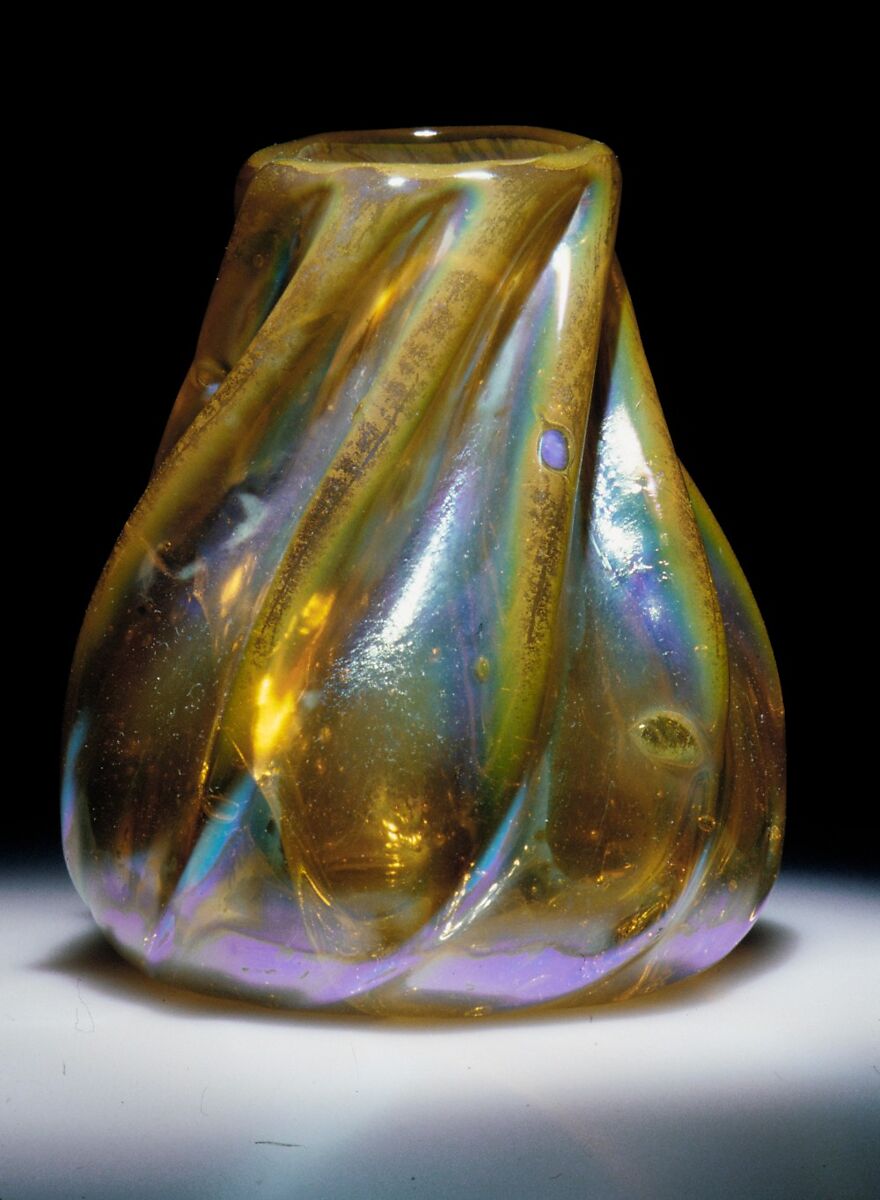
The Tiffany vase pictured here is a comparison from The Metropolitan Museum of Art, not an object in the Bronfman pledge. Designed in 1893, it entered The Met in an 1896 gift from the Havemeyers. The museum records that group as its first acquisition of American glass.
A modest vessel and an institutional decision can belong to the same history. Ottawa’s announcement raises the question again: what changes when a museum commits not only to collecting a material, but also to sustaining the knowledge around it?
Sources
- National Gallery of Canada: corrected official announcement, 20 November 2026, via CNW
- Annabel Keenan, The Art Newspaper: independent report, 20 November 2026
- Corning Museum of Glass: definition and origins of studio glass
- The Met: Tiffany vase, 1893, object 96.17.44, and the Havemeyer gift
Image credit: Illustrative comparison, not part of the Bronfman gift: Vase, 1893, designed by Louis C. Tiffany, made by Tiffany Glass and Decorating Company; Favrile glass. The Metropolitan Museum of Art, Gift of H. O. Havemeyer, 1896, accession 96.17.44. Image: The Met collection, public domain, provided under CC0 through The Met Open Access. Displayed at reduced size; previews may be cropped.
