
Berlin
A Plexiglas Violin Changes How You Look at Sculpture
Berlin’s coming Klangkörper exhibition places musical instruments inside the Bode-Museum’s collection. A violin made in captivity and a medieval orchestra offer two ways into its dialogue between bodies, objects and sound.
A violin made from Plexiglas in Foggia, Italy, in 1946 is one of the objects introducing Berlin’s forthcoming Klangkörper exhibition. The museum identifies its maker as F. Krolikowski and describes it as an amateur work made during captivity as a prisoner of war. Before a note is heard, the instrument already carries a history of making under constraint.
The Bode-Museum lists the exhibition’s public run as 24 November 2026–7 March 2027. Today’s scheduled press preview is separate from that visiting period. Developed with the Musikinstrumenten-Museum and Hamburger Bahnhof, the project inserts musical instruments into the sculpture collection rather than sending them into a detached history of music.
An orchestra inside an altarpiece
The published wall texts describe seventeen stations within the permanent displays. One juxtaposes the Minden Altarpiece’s forty musical angels with two 1960s combo organs: an Italian Farfisa and the East German Weltmeister TO 200/5. Both the pictured ensemble and the electronic instruments pursue a way of gathering many sounds together.
The comparison is more interesting than a visual resemblance. An altarpiece organises a sacred community; a keyboard offers a player a range of voices. Looking between them can make a familiar technology seem less inevitable. Someone had to imagine what one instrument, or one image, ought to contain.
A shape is also a way of producing sound
The exhibition’s advance release proposes treating instruments as sculptural objects in their own right. Its route moves between instrument families and works of art associated with music, including Canova’s Dancer. Selected sounds will be available through audio examples.
That distinction matters. A body carved in motion and an instrument designed to vibrate ask for different kinds of attention. One preserves a gesture; the other is built to make an event possible. Put together, they invite a visitor to notice posture, hollow space, material and the relationship between a hand and an object.
Nevin Aladağ’s sound-producing sculptures made from everyday objects add a contemporary perspective. When does a familiar thing become an instrument? Her work extends the question beyond historical craftsmanship.
Listen without assuming everything can be played
This is a preview based on the museum’s published programme, not a report from inside the installed exhibition. Its promise is a changed way of looking through an existing collection. Visitors can ask what a depicted instrument tells us about the person holding it—and what an actual instrument reveals that its image cannot.
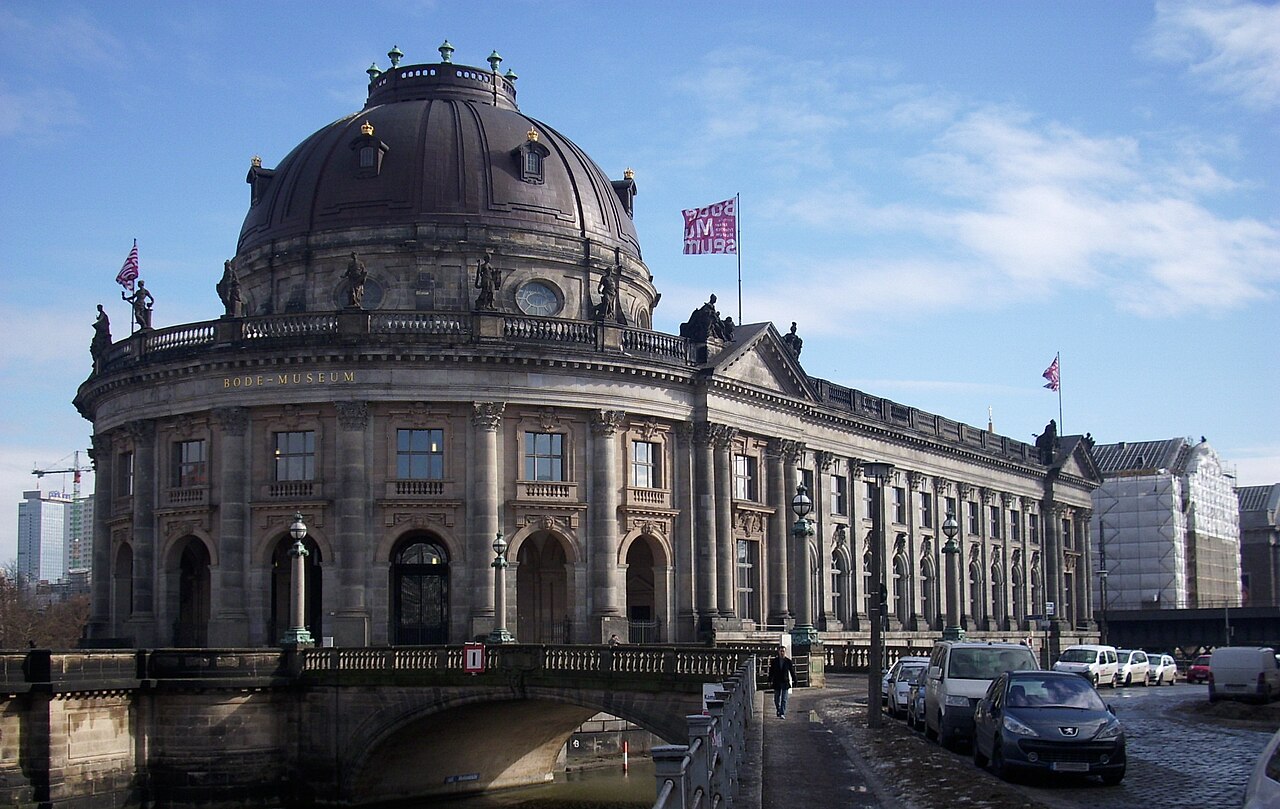
The venue is Am Kupfergraben, 10178 Berlin, with entry via Monbijoubrücke. The official exhibition page carries the current opening hours. The listed start date is Tuesday, 24 November; the separate opening event should not be confused with the regular exhibition run.
Sources
- Staatliche Museen zu Berlin: exhibition dates, partners and visitor access
- Bode-Museum: object credits and press preview on 20 November
- Bode-Museum: advance exhibition release, 27 August 2026 (PDF)
- Bode-Museum: bilingual gallery texts, seventeen stations (PDF)
Image credit: C.Mezzo-1, 25 February 2010, via Wikimedia Commons. Released into the public domain by the photographer; the linked file page documents unrestricted reuse. Archival exterior of the venue, not an exhibition view or an image of the Plexiglas violin. Reduced in size; previews may be cropped.

