
Art World
Banksy Sends the Police Into Basquiat’s Painting
Opening in Raleigh on 22 November, Basquiat × Banksy puts a boy and a dog beside their later transformation into a stop-and-search scene. Two large paintings show how a borrowed image can acquire a different politics.
A boy raises his arms beside a dog. In one painting, the figures occupy a field of restless colour. In another, the scene has become a police encounter: an officer searches the boy while a second writes. The repeated pose makes the difference between the two images difficult to miss.
Basquiat × Banksy opens today, 22 November 2026, at the North Carolina Museum of Art in Raleigh. The free presentation places Jean-Michel Basquiat’s Boy and Dog in a Johnnypump (1982) beside Banksy’s Banksquiat. Boy and Dog in Stop and Search (2018). It runs through 30 May 2027 in the East Building, Level A.
What changes when the figure stays?
The museum’s descriptions provide a precise starting point. Basquiat’s skeletal boy has raised, oversized hands; red, pink, grey, ochre and green surround him and his dog. Banksy repeats the figures in a largely grey scene, adding the two police officers.
The comparison invites us to reconsider the raised arms. A gesture does not carry a fixed meaning independent of its surroundings. In Banksy’s version, the act of searching turns the body into the object of someone else’s authority. Recognition happens first; the new situation follows a moment later.
That is what makes the pairing more interesting than a meeting of famous names. Borrowing an image can do more than signal admiration. It can redirect the viewer’s attention, making a familiar composition serve a new argument. The source remains visible, so the response can be judged against it.
Two surfaces, two moments
These are not matching prints. The museum records Basquiat’s work as acrylic, crayon and spray paint on canvas, and Banksy’s as acrylic and wax marker on birch wood. Both are monumental paintings, made thirty-six years apart.
Thinking about those differences helps keep Basquiat’s work from becoming merely a stepping stone to Banksy’s comment. Colour, marks and support are part of what a painting does. A later artist’s interpretation is one possible reading, not the final explanation of the earlier image.
A travelling conversation
The exhibition originated at the Smithsonian’s Hirshhorn Museum and Sculpture Garden, where its recorded run began in September 2024 and ended in September 2026. Betsy Johnson organised the project. Raleigh’s opening is a new stop for an existing curatorial proposition, rather than the first encounter between these paintings.
For viewers, the useful question is not simply which artist is more recognisable. It is how much of the first image survives in the second, and what the addition of authority makes us see differently. Two works can sustain that question without requiring a survey of either artist’s entire career.
Sources
- NCMA: current exhibition, descriptions, media and free admission
- NCMA: official announcement and exhibition origins
- Hirshhorn: original presentation, dates and curator
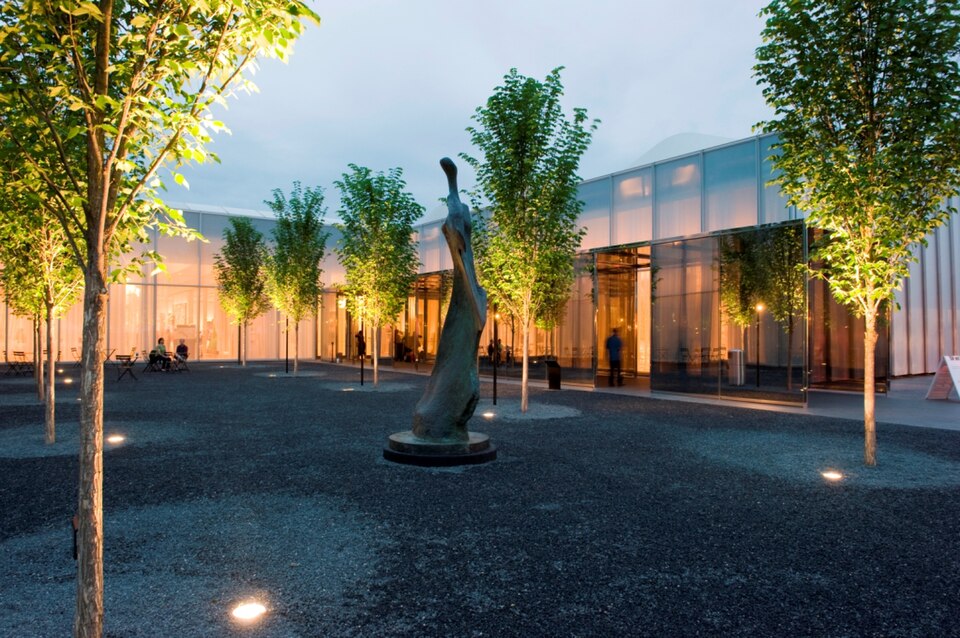
Image credit: NC Museum of Art, West Building Entrance Canopy, 1 May 2010, via Wikimedia Commons. Attribution permission explicitly allows commercial use and derivative works. Archival photograph of the museum’s West Building; the exhibition is in the East Building. Not an artwork reproduction or installation view. Reduced in size; previews may be cropped.


